Put a Family Calendar on Your Smart TV (Samsung, LG and the rest)
Yes, if your TV has a web browser — and Samsung's Tizen sets and LG's webOS sets both do. Open the browser, type the address, and the dashboard fills the screen. No app, no account, no casting.
But know the limit up front: a television is built to stop showing a still picture. That makes it a fine screen to glance at and a poor always-on panel. The honest version of both halves is below.
What you need
DinkyDash is a web page, not an app you install. So there are two parts:
- Something to serve it. A Raspberry Pi or an old computer on your Wi-Fi — free, MIT licensed, and about an evening's work. Or start a free 14-day hosted trial, no card required.
- The TV, which is the screen. It opens that address in the browser it already has.
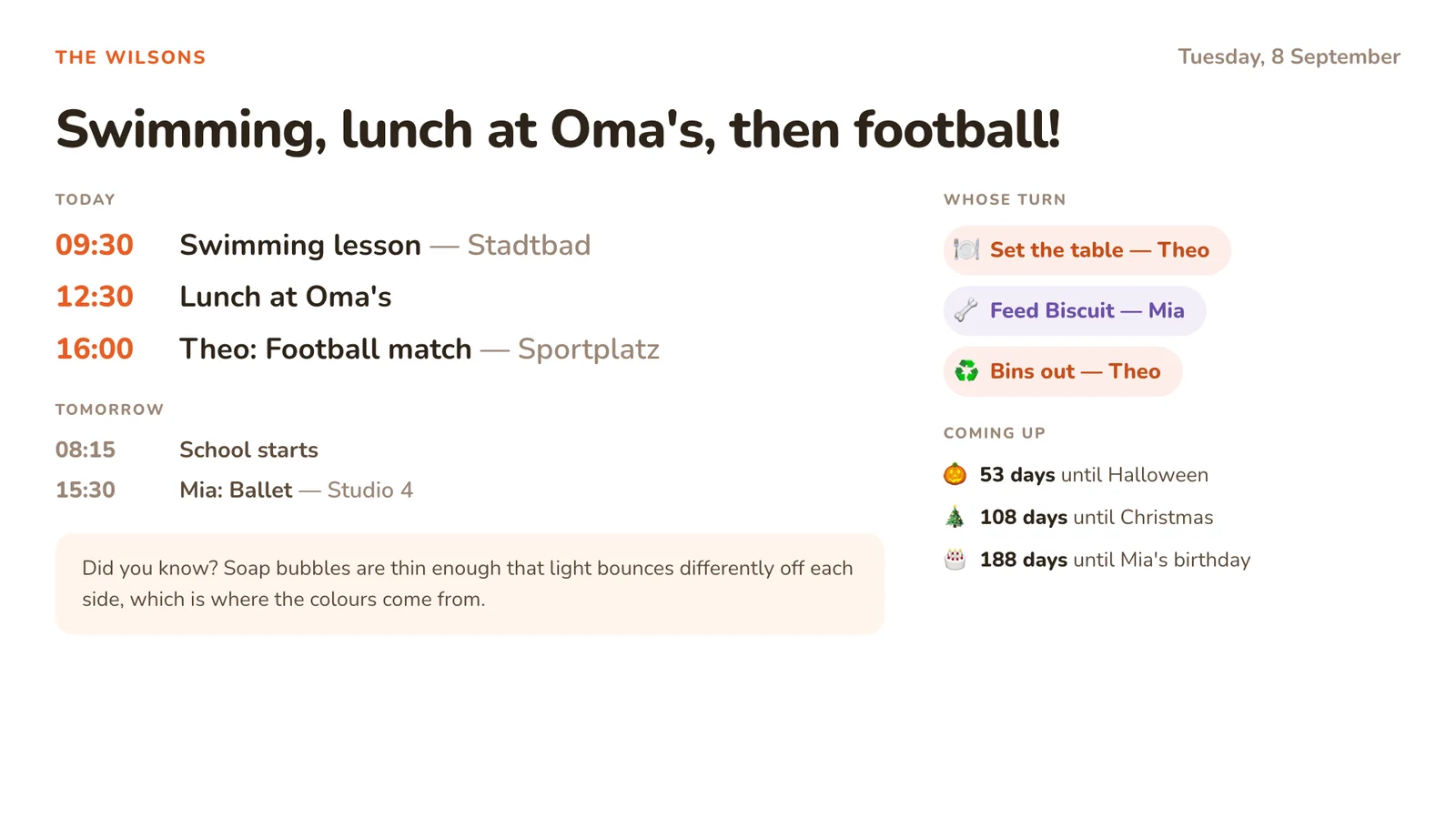
On a 16:9 screen the dashboard splits into two columns by itself, and sizes its own type to the display. Nothing needs configuring for a particular television.
Set it up
1. Find the browser. On Samsung, it's Internet, in the apps row on the home bar. On LG, it's Web Browser, in the launcher. On an Android TV or Google TV box there is usually no browser preinstalled — install Chrome, or use a Fire TV stick instead.
2. Type the address, once. If we host it, that's the screen link under Settings → The screen: app.dinkydash.co/s/ and twelve characters, with no letters that are easy to confuse. If you run it yourself, it's the address of the machine serving it on your network, something like http://192.168.1.50:5000.
Typing that with a remote is the worst part of this whole page. Two ways to make it survivable:
- Pair a Bluetooth keyboard to the TV for the one minute it takes.
- Use the TV maker's phone app — SmartThings for Samsung, the LG ThinQ remote — which gives you a phone keyboard instead of an on-screen grid.
3. Bookmark it. Then you never type it again. Both browsers open on their bookmarks, so the dashboard is two clicks from the home screen for good.
The honest limit
Most TVs switch to a screensaver after about 30 minutes without a button press. That's not a bug you can configure away on every set:
- Samsung and LG LCD sets usually let you turn the screensaver off, or lengthen it, under the general or power settings. Look for Screen saver, Auto power off or Energy saving.
- OLED sets do it deliberately, and on many of them the option is missing entirely. An OLED panel can retain a static image permanently, so the manufacturer moves or dims the picture on purpose. That's the panel protecting itself, and you should let it.
There's a second, plainer problem: a television is in the living room. A family calendar earns its keep in the kitchen or the hall, where people pass it on the way out of the door.
So the fair summary is: a smart TV is a good way to put the day on the big screen for a minute, and the wrong device to leave it on all day. If what you want is an always-on panel, an old tablet or a Raspberry Pi does that job properly and costs a fraction of a television.
What ends up on the screen
- Today's events, merged from every calendar you add: Google, iCloud, Outlook and Cozi each publish a link, and each has its own page here with the steps.
- A chore chart that rotates, moving on one person a day by itself.
- Countdowns to birthdays, Christmas and the school holidays.
- A headline, written fresh each day by Claude, around your family's actual day.
The dashboard refreshes itself every five minutes, and if the Wi-Fi drops it keeps the last dashboard on screen with a small "Reconnecting" note rather than an error page. The script that does it's written for old browsers, and one too old for it, or with JavaScript switched off, falls back to a plain HTML refresh — which matters here more than anywhere: TV browsers are the oldest browsers in the house, and this one keeps working in them.
What it costs
Nothing beyond the television you already own. DinkyDash is free and MIT licensed with no subscription for the self-hosted version, and the only running cost is the headline — a Claude API call once a day, roughly $0.13 a month, and the dashboard works without it.
Other screens
- Fire TV — if your TV has no browser, a Fire Stick gives it one
- iPad — the best cheap always-on panel
- Android tablet — the same, cheaper second-hand
- Raspberry Pi — the tidiest permanent panel, about $150
- Echo Show — the one that doesn't work, and why
Start here
The setup guide covers the other half: getting DinkyDash running, adding your calendars, and pointing a screen at it. The code is on GitHub under an MIT licence.
Rather skip the setup? Start a free 14-day hosted trial, no card required.
Last updated 2026-10-09.